

The HealthspanX Journal
What Is NMN? Nicotinamide Mononucleotide, Explained
NMN (nicotinamide mononucleotide) is a natural precursor to NAD+. Learn how it works, what human trials have measured, what remains uncertain, and how NMN differs from other NAD+ precursors.
Follow the sources, inspect what was measured, and keep the study’s methods and limitations in view.
NMN stands for nicotinamide mononucleotide. It is a naturally occurring molecule involved in the body's production of nicotinamide adenine dinucleotide, better known as NAD+. NAD+ is a coenzyme that cells use in energy metabolism, redox reactions, cellular signaling, DNA-damage responses, and other essential biological processes.
That relationship between NMN and NAD+ is established biochemistry. The larger question is whether taking NMN as a supplement produces meaningful health, performance, or longevity benefits in people. Human research now shows that oral NMN can affect NAD-related biomarkers, and short-term trials have generally reported good tolerability in the populations studied. But evidence for broader clinical benefits is much less certain.
This distinction is important. Showing that a supplement changes NAD+ metabolism is not the same as showing that it slows aging, prevents disease, improves every aspect of health, or extends human lifespan.
What does NMN stand for?
NMN is short for nicotinamide mononucleotide. Chemically, NMN is a nucleotide made from three main components: a nicotinamide group, a ribose sugar, and a phosphate group.
NMN exists naturally as an intermediate in the network of reactions that creates and recycles NAD+ inside the body. In other words, NMN is not simply a substance added from outside through supplements. Human cells already produce, transform, and use NMN as part of normal metabolism.
You may also encounter terms such as beta-NMN, β-NMN, beta-nicotinamide mononucleotide, or beta-D-NMN. NMN can exist in different stereochemical forms, but beta-NMN is the biologically relevant form directly involved in NAD+ biosynthesis and the form generally discussed in human supplementation research.
NMN should not be confused with nicotinamide, niacinamide, niacin, nicotinamide riboside (NR), NAD+, NADH, or NMNH. They are related through vitamin B3 and NAD metabolism, but they are different molecules with different positions in those pathways.
Is NMN just vitamin B3?
No. NMN is related to vitamin B3 metabolism, but NMN is not the same molecule as vitamin B3.
Vitamin B3 refers primarily to compounds such as niacin and nicotinamide. The body can use nicotinamide as part of its NAD+ salvage pathway. An enzyme called nicotinamide phosphoribosyltransferase, or NAMPT, helps convert nicotinamide into NMN. NMN can then be converted into NAD+.
A simplified version of the pathway looks like this:
Nicotinamide → NMN → NAD+
That pathway explains why NMN is sometimes described as a vitamin-B3 derivative or NAD+ precursor. But calling NMN "just vitamin B3" hides important chemical and biological differences between the molecules.
For a deeper comparison with nicotinamide and other vitamin-B3-related compounds, see our guide to NMN vs nicotinamide.
What does NMN do in the body?
NMN's best-established biological role is as an intermediate in NAD+ biosynthesis.
Inside cells, enzymes called nicotinamide mononucleotide adenylyltransferases, or NMNATs, can convert NMN into NAD+. That makes NMN one of the molecules the body can use to maintain the NAD+ pool required for normal cellular function.
NAD+ performs two especially important categories of work.
NAD+ helps transfer energy through metabolic reactions
NAD+ participates in oxidation-reduction, or redox, reactions. In these reactions, NAD+ and its reduced form NADH help transfer electrons through metabolic pathways involved in converting nutrients into usable cellular energy.
This is one reason NAD+ is closely connected with mitochondrial function and energy metabolism. It does not mean, however, that increasing NAD+ automatically gives someone more subjective energy or produces a measurable performance benefit.
NAD+ is also consumed by signaling and repair enzymes
NAD+ is used as a substrate by several families of enzymes, including sirtuins, poly(ADP-ribose) polymerases, commonly called PARPs, and NAD-consuming enzymes such as CD38.
These systems participate in processes that include metabolic regulation, stress responses, DNA-damage signaling, inflammation, circadian biology, and cellular communication.
This broad biological reach helps explain why NAD+ metabolism has become an important area of aging research. It also explains why mechanistic findings can easily be overinterpreted. A molecule participating in an aging-related pathway is not automatically an anti-aging treatment.
For the complete pathway, including the difference between NMN and NAD+, see NMN and NAD+: how the pathway works.
Is NMN naturally present in the human body?
Yes. NMN is an endogenous metabolite, meaning the body naturally produces and uses it.
Much of the body's NMN is generated through pathways that recycle nicotinamide back toward NAD+. NMN can also arise through pathways involving other NAD+ precursors.
The metabolism is more complicated than a single straight line. Different tissues use different enzymes, precursor pathways, transport processes, and rates of NAD+ synthesis and consumption. The gut microbiome may also influence the metabolism of orally consumed NAD+ precursors.
This complexity is why questions about how much supplemental NMN reaches the bloodstream intact, how it enters different tissues, and how much is transformed before reaching its destination remain active research areas.
Our dedicated guide to NMN absorption and bioavailability examines those questions in detail.
Is NMN found naturally in food?
Yes. Small quantities of NMN have been measured in several foods.
| Food or food group | Reported NMN amount | What this means |
|---|---|---|
| Edamame | Approximately 0.47–1.88 mg per 100 g | Among the higher concentrations reported in commonly cited food measurements. |
| Avocado | Approximately 0.36–1.60 mg per 100 g | Contains measurable NMN, but still in milligram-scale food quantities. |
| Seafood and raw meats | Approximately 0.06–0.42 mg per 100 g in reported measurements | Generally trace quantities compared with supplemental study doses. |
| Broccoli, cabbage, cucumber, tomato and other foods | Small measured quantities | These foods contribute dietary exposure but are not equivalent to concentrated supplementation. |
The difference in scale matters. Human supplementation studies have commonly tested NMN in quantities measured in hundreds of milligrams per day, whereas normal foods contain much smaller amounts.
That does not make food-derived NMN unimportant. It simply means that saying "NMN occurs naturally in food" should not be interpreted as saying a serving of vegetables delivers the same exposure as an NMN supplement.
See NMN foods and natural sources for the detailed food-composition evidence.
Why is NMN associated with NAD+ and aging?
The interest in NMN did not begin with supplements. It grew from decades of research into NAD+ biology.
NAD+ metabolism changes with age. Multiple studies have reported lower NAD+ availability or altered NAD+ metabolism in older tissues and organisms, although the size and nature of those changes can vary by tissue, health status, measurement technique, and population.
At the same time, NAD+ is required by cellular systems involved in metabolism, stress responses, mitochondrial biology, DNA-damage responses, inflammation, and other processes relevant to aging.
Researchers therefore began asking a logical question: if age-associated changes in NAD+ metabolism contribute to declining cellular function, could restoring NAD+ availability improve some of those functions?
NMN became one way to test that hypothesis because it sits directly inside NAD+ biosynthesis.
Animal research generated much of the excitement
In mice and other experimental models, NMN supplementation has been studied across metabolism, insulin sensitivity, mitochondrial function, physical activity, cardiovascular biology, brain and nerve function, reproduction, eye health, and age-associated physiological decline.
Some of those findings are substantial. They establish that manipulating NMN and NAD+ metabolism can have important biological effects under experimental conditions.
But animal studies answer a different question from human clinical trials.
An effect in a mouse does not establish that the same outcome will occur in a person. Species differences, dose, route of administration, lifespan, disease model, tissue exposure, metabolism, and study endpoint can all change the result.
This is the central evidence boundary in NMN research: strong biological plausibility is not the same thing as demonstrated human benefit.
For the aging-specific evidence, see NMN and longevity: what the anti-aging research actually shows.
What do human studies on NMN actually show?
Human NMN research has progressed considerably beyond the earliest safety studies. Researchers have now investigated NAD-related biomarkers, insulin sensitivity, exercise physiology, physical function, sleep-related outcomes, vascular measures, and short-term tolerability.
The pattern that emerges is more nuanced than either "NMN works" or "NMN does nothing."
Evidence is strongest for biological target engagement: oral NMN can alter NAD+ metabolism in humans. Evidence for specific health or functional outcomes exists, but it is more heterogeneous and often comes from relatively small, short trials.
| Research question | What human evidence currently supports | What it does not establish |
|---|---|---|
| Does oral NMN affect NAD+ metabolism? | Multiple studies report increases in NAD+, NMN, or related NAD metabolites depending on the sample and assay. | That a larger biomarker change automatically improves health. |
| Does NMN improve metabolic health? | A small randomized trial found improved skeletal-muscle insulin sensitivity in a specific group of postmenopausal women with prediabetes and overweight or obesity. | A general treatment effect for diabetes, prediabetes, weight loss, glucose control, or metabolic disease. |
| Does NMN improve exercise performance? | A randomized runner study reported favorable changes in ventilatory-threshold measures at some doses. | A universal improvement in VO₂max, peak performance, strength, body composition, or athletic performance. |
| Does NMN improve physical function in older adults? | Some trials report selected gait, lower-limb, drowsiness, or related functional signals. | Prevention of frailty, disability, or age-related functional decline. |
| Does NMN improve vascular health? | Some studies report signals in blood-pressure or arterial-stiffness-related measurements. | Prevention of heart attack, stroke, heart failure, or cardiovascular death. |
| Does NMN slow aging? | Human trials show biochemical and selected functional effects worthy of continued study. | That NMN slows, stops, or reverses human aging or extends human lifespan. |
Early human safety and metabolism studies
One of the earliest human studies tested single oral doses of 100, 250, and 500 mg of NMN in healthy Japanese men. The doses were metabolized without a major acute safety signal in that small study.
Later studies moved from single-dose experiments toward repeated supplementation and randomized designs.
Muscle insulin sensitivity
A randomized trial in postmenopausal women with prediabetes and overweight or obesity tested 250 mg of NMN daily for 10 weeks. The study reported an improvement in skeletal-muscle insulin sensitivity.
That finding is scientifically important because it demonstrates a human physiological effect beyond simply moving an NAD-related biomarker.
But other metabolic effects observed in animal models did not broadly translate in the same study. The trial was also small and involved a very specific population. It does not establish NMN as a treatment for diabetes, prediabetes, obesity, or metabolic disease in the general population.
Exercise physiology
A six-week randomized study in trained amateur runners tested placebo and NMN doses of 300, 600, and 1,200 mg per day alongside exercise training.
The study reported favorable dose-related changes in several measurements around the first and second ventilatory thresholds, particularly in the medium- and high-dose groups.
However, important outcomes did not improve significantly, including VO₂max, peak measures, and body composition.
This is a useful example of why endpoint-specific reporting matters. A positive exercise-physiology finding should not be rewritten as "NMN boosts athletic performance" without qualification.
Older-adult physical function, sleep and fatigue
Other randomized studies have explored NMN in older adults and reported selected signals involving walking, lower-limb function, drowsiness, fatigue, or sleep-related outcomes.
These findings are interesting, but they do not yet form a large, consistent body of evidence showing that NMN reliably improves energy, sleep, strength, or physical function for everyone.
The dedicated NMN human trials guide reviews the clinical studies directly, including their populations, doses, durations, positive findings, null findings, and limitations.
What do systematic reviews and meta-analyses add?
Individual small trials can produce interesting signals. Systematic reviews and meta-analyses help answer a different question: when multiple randomized trials are considered together, do consistent effects emerge?
A 2026 systematic review and meta-analysis pooling 15 parallel randomized NMN trials found generally favorable short-term tolerability across the studied populations and regimens. However, it did not find clear pooled benefits for several broad metabolic outcomes, including body weight, BMI, fasting glucose, HbA1c, blood lipids, or overall systolic blood pressure.
This does not prove that NMN has no biological effects. It shows why a narrow positive endpoint from one study should not be expanded into a broad promise.
The current evidence supports a more precise conclusion:
NMN is biologically active in humans, but broad clinical effectiveness has not been established.
What are the potential benefits of NMN?
NMN is being researched across several health domains because NAD+ biology touches many cellular systems. The evidence, however, is not equally strong for every proposed benefit.
| Area of interest | Current evidence picture |
|---|---|
| NAD+ metabolism | Human evidence supports target engagement. Multiple trials show changes in NAD+ or related metabolites. |
| Metabolic health | Mixed and population-specific. A positive muscle insulin-sensitivity trial exists, while broader pooled glucose, lipid, and body-weight effects remain unconvincing. |
| Exercise and physical function | Preliminary human signals. Some ventilatory-threshold and selected physical-function findings have been reported, alongside important null outcomes. |
| Cardiovascular and vascular health | Early human evidence. Blood-pressure and arterial-stiffness markers are being studied, but cardiovascular-event prevention has not been demonstrated. |
| Sleep, fatigue and perceived energy | Limited human evidence. Selected studies report signals, but the evidence is not sufficient for a broad sleep or energy claim. |
| Brain and cognitive health | Predominantly preclinical. Human cognitive-benefit evidence remains limited. |
| Healthy aging and longevity | Mechanistically plausible but clinically unproven. No human study demonstrates lifespan extension or reversal of aging. |
For a claim-by-claim review, use the dedicated NMN benefits guide rather than assuming that every preclinical effect is a human benefit.
Does NMN reverse aging?
No human evidence currently demonstrates that NMN reverses aging.
The phrase "anti-aging" can refer to several very different ideas: altering an aging-related pathway, changing a biomarker, improving one age-associated function, changing a biological-age measure, delaying disease, extending healthspan, or extending lifespan.
Those outcomes are not interchangeable.
NMN clearly interacts with a pathway that is relevant to aging biology. Animal research has also produced substantial findings. Human trials have demonstrated biochemical effects and some endpoint-specific signals.
None of that establishes that a person taking NMN becomes biologically younger, ages more slowly in a clinically validated way, avoids age-related disease, or lives longer.
This distinction is essential because the scientific rationale for studying NMN is stronger than the evidence behind many consumer anti-aging claims.
How strong is the evidence for NMN?
A useful way to understand the field is to separate the evidence into layers rather than treating every study as equivalent.
| Evidence layer | Current status |
|---|---|
| Basic biochemistry | Established. NMN is an intermediate in NAD+ biosynthesis. |
| Cell and animal research | Extensive. Numerous mechanisms and physiological effects have been demonstrated in experimental models. |
| Human NAD+ target engagement | Supported. Multiple human studies show changes in NAD+ or related metabolites after oral NMN. |
| Specific human functional outcomes | Preliminary and heterogeneous. Positive findings exist, but so do null results and population-specific effects. |
| Broad disease prevention | Not established. |
| Reversal of human aging | Not established. |
| Extension of human lifespan | Not demonstrated. |
| Long-term safety over years | Not established. |
This evidence ladder is why HealthspanX separates the NMN research overview, human trials, benefits, and individual Evidence Center records rather than collapsing every type of evidence into one claim.
Is NMN safe?
Published human studies have generally found oral NMN to be well tolerated over the relatively short durations studied.
A 2026 meta-analysis pooling 15 parallel randomized trials did not identify a clear overall increase in adverse events, serious adverse events, adverse-event-related withdrawal, major system-specific adverse-event categories, or pooled ALT and AST liver-enzyme levels.
That is reassuring, but it has an important boundary: most NMN trials are measured in weeks or months, not years.
Short-term tolerability is not proof of lifelong safety.
Several areas remain under-studied, including long-term continuous use, pregnancy and breastfeeding, significant liver or kidney disease, complex medication regimens, and some disease populations.
Potential interactions between NMN and medications also have not been comprehensively mapped. "No known interaction" should therefore not be interpreted as "proven safe together."
Cancer questions require particular care because NAD+ metabolism is important to both normal and malignant cells. Current evidence does not establish that NMN causes cancer in humans, but it also does not justify treating NMN as universally appropriate for people with active cancer or complex oncologic histories.
For the full risk review, see NMN side effects and safety, NMN drug interactions, and NMN and cancer.
What doses of NMN have been studied?
Human studies have used a wide range of NMN doses rather than one universally accepted amount.
Early work examined single doses from 100 to 500 mg. Other randomized trials have used approximately 250 mg per day, while exercise and higher-dose studies have tested 600 mg, 1,200 mg, 1,250 mg, and other regimens.
Across the randomized studies included in a 2026 safety meta-analysis, daily doses ranged roughly from 250 to 2,000 mg, with intervention periods ranging from about 14 days to 24 weeks.
These figures describe research exposure. They should not be turned into a universal dosing recommendation.
A dose being studied does not mean it has been established as optimal.
The ideal dose could depend on the outcome being tested, age, health status, formulation, duration, pharmacokinetics, baseline NAD metabolism, and other factors. Human evidence has not established a single NMN dose that is best for everyone.
Questions about morning versus evening use, taking NMN with food, dose-response, frequency, and trial doses belong in the dedicated NMN dosage guide.
NMN vs NAD+: are they the same thing?
No. NMN and NAD+ are different molecules with different roles.
NMN is a precursor that can be used in NAD+ biosynthesis. NAD+ is the resulting coenzyme used throughout metabolism and cellular signaling.
A useful shorthand is:
NMN = precursor
NAD+ = coenzyme
This distinction also explains why asking whether "NMN is better than NAD+" cannot be answered simply from their positions in a biochemical pathway.
The practical comparison requires evidence about absorption, metabolism, delivery route, tissue exposure, safety, and actual human outcomes. A compound being closer to the final molecule in a pathway does not automatically make it a better supplement.
For that question, see NMN vs NAD+: differences, conversion and human evidence.
What is the difference between NMN and NR?
Nicotinamide riboside, or NR, is another NAD+ precursor. NR and NMN are chemically related but not identical.
Both can contribute to NAD+ biosynthesis, and both have been studied in humans. Their metabolism can intersect: NR can be phosphorylated to form NMN, while extracellular processing and other pathways can complicate the idea that every orally consumed precursor simply enters cells intact.
That means claims such as "NMN is one step closer to NAD+, therefore it must be better than NR" are too simplistic.
Comparing the two requires looking at human pharmacokinetics, NAD+ responses, clinical endpoints, safety, dose, formulation, and evidence quality.
See NMN vs NR for the full comparison.
What should you look for in an NMN supplement?
The existence of human NMN research does not mean every commercial NMN product is equivalent to the materials used in clinical trials.
If someone is evaluating an NMN supplement, several product-level questions matter:
- Identity: Is the ingredient actually beta-NMN?
- Purity: Is there analytical evidence supporting the stated purity?
- Dose accuracy: Does the finished product contain the amount stated on the label?
- Contaminant testing: Has the product been evaluated for relevant contaminants?
- Batch consistency: Is testing tied to actual production batches rather than generic marketing claims?
- Stability: Are storage, packaging, moisture, heat, and shelf-life considerations addressed?
- Formulation claims: Are claims about liposomal, sublingual, powder, capsule, or other delivery formats supported by comparative human evidence?
Recent research on NMN manufacturing also highlights why product characterization matters. Production methods can differ in stereochemical purity, impurities, batch consistency, and analytical control.
Product quality and clinical effectiveness are also separate questions. A highly pure NMN product may accurately contain NMN, but purity alone does not prove that the supplement will produce a particular health outcome.
See NMN purity and quality testing for the analytical side, and how to evaluate the best NMN supplements for the broader buying methodology.
Is NMN worth taking?
This is one of the most important questions in the current NMN search landscape, and the evidence does not support a universal yes or no.
The scientific case for continuing to study NMN is strong. NMN has a real biochemical role in NAD+ metabolism, oral supplementation is biologically active in humans, short-term tolerability has generally been favorable in trials, and some specific clinical endpoints have produced positive results.
At the same time, the evidence does not establish that NMN reverses aging, extends human lifespan, reliably produces weight loss, prevents chronic disease, improves cognition for healthy adults, or provides the same benefit to every person.
Whether supplementation is worthwhile therefore depends on what "worth it" means.
If the expectation is that NMN is a proven anti-aging therapy, the evidence does not support that expectation.
If the question is whether NMN is a biologically credible NAD+ precursor with an expanding human research base, the answer is yes.
If the question is whether a particular person should take it, that becomes an individual health decision involving age, goals, medications, medical history, product quality, cost, uncertainty, and tolerance for an evidence base that is still developing.
What do we still not know about NMN?
Despite the growth of the field, several questions remain unresolved.
- Long-term safety: Most controlled human trials are short compared with the years people may use supplements.
- Long-term effectiveness: We do not know whether years of NMN use change disease incidence, disability, healthspan, or lifespan.
- Optimal dose: No universal evidence-based NMN dose has been established.
- Who benefits most: Positive findings may depend on age, baseline metabolic state, sex, training status, or other characteristics.
- Tissue exposure: Blood NAD+ changes do not necessarily tell us what happens in every organ or cell type.
- Absorption and metabolism: The relative contributions of intact NMN uptake, extracellular conversion, microbiome metabolism, and downstream pathways remain areas of active study.
- Clinical significance of NAD+ changes: There is no universally validated consumer target for an "optimal" NAD+ level.
- Medication interactions: Many common drug-supplement combinations have not been tested directly.
- Special populations: Evidence is limited during pregnancy, breastfeeding, active cancer, and significant liver or kidney disease.
- Product equivalence: Research using one characterized NMN material does not automatically validate every product or delivery system sold as NMN.
These are not minor details. They define the difference between what NMN research currently shows and what future studies still need to establish.
How to read NMN claims without getting misled
NMN sits at the intersection of legitimate aging biology, supplement marketing, emerging human trials, and intense consumer interest. That makes careful interpretation especially important.
When you encounter an NMN claim, ask four questions.
- Was the evidence from cells, animals, or humans? A mechanism or mouse result is not automatically a human benefit.
- What was actually measured? A rise in NAD+ is different from improved function, and improved function is different from disease prevention or longer life.
- Was the result compared with an appropriate control? Before-and-after changes alone can be misleading.
- What did the study not find? Null endpoints, sample size, duration, population, and study limitations are part of the evidence, not footnotes to ignore.
A useful rule is to separate mechanism, target engagement, clinical outcome, and long-term health outcome.
NMN has strong evidence for its place in NAD+ biology. Human target engagement is increasingly supported. Certain clinical outcomes have preliminary positive evidence. Broad anti-aging and longevity outcomes remain unproven.
The bottom line on NMN
NMN, or nicotinamide mononucleotide, is a naturally occurring nucleotide and an intermediate in the body's production of NAD+. Its biological role is real, and oral NMN has been shown to affect NAD-related metabolism in human studies.
That makes NMN scientifically interesting. It does not make every claim made about NMN scientifically established.
Human research has reported selected positive findings in areas such as muscle insulin sensitivity, exercise physiology, physical function, and NAD+ biomarkers. Other endpoints have been null, and pooled research has not demonstrated broad improvements across many metabolic outcomes.
Short-term human safety data are generally reassuring in the studied populations, while long-term safety and many special-use scenarios remain insufficiently characterized.
Most importantly, NMN has not been shown to reverse human aging or extend human lifespan.
The best way to understand NMN is therefore not to choose between "miracle anti-aging molecule" and "useless supplement." The evidence supports a more precise position: NMN is a biologically important NAD+ precursor with genuine human target engagement, promising but inconsistent outcome research, and major questions that still require larger and longer clinical trials.
Continue exploring the NMN evidence
This article is the definition and orientation point for the HealthspanX NMN knowledge system. Use the dedicated resources below when you want to go deeper into a specific question.
- NMN and NAD+ — how NMN fits into NAD+ metabolism and whether NMN and NAD+ are the same thing.
- NMN absorption and bioavailability — what may happen after oral NMN is taken.
- NMN foods and natural sources — measured food concentrations and what dietary exposure means.
- NMN research — the broader scientific landscape, from mechanism to systematic reviews.
- NMN human trials — trial-by-trial clinical evidence, including positive and null findings.
- NMN benefits — an outcome-by-outcome assessment of potential benefits and evidence strength.
- NMN and longevity — the evidence behind anti-aging and lifespan claims.
- NMN safety and side effects — adverse events, long-term unknowns, special populations, and risk questions.
- NMN dosage — doses used in trials, timing, dose-response evidence, and what has not been established.
- NMN Evidence Center — HealthspanX study-level analyses, source identifiers, limitations, and evidence records.
For education and general information. This article does not replace advice from a qualified healthcare professional.
Keep exploring
A little more perspective.
October 02, 2025
FDA Declares NMN Lawful In Dietary Supplements 2025: What You Need To Know
The FDA has officially reversed its 2022 position and now recognizes beta-nicotinamide mononucleotide (NMN) as a lawful dietary supplement in the U.S. This landmark decision restores...
Read article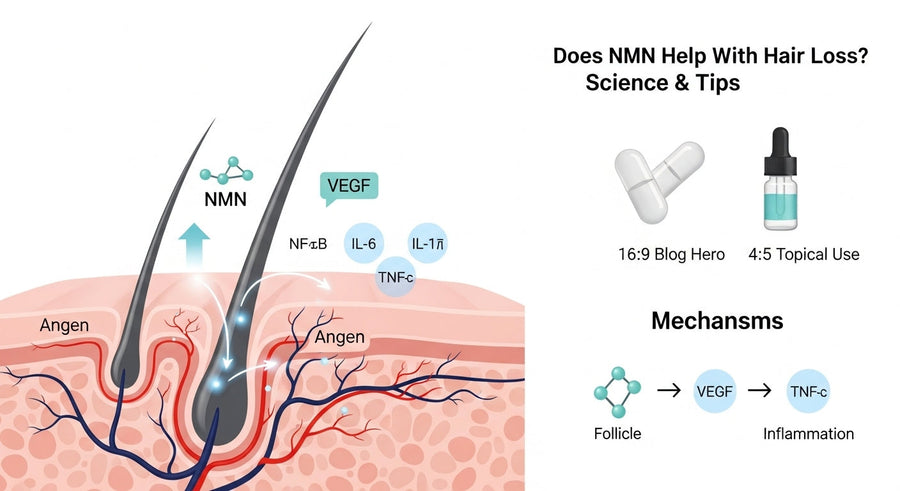
October 02, 2025
Does NMN Help With Hair Loss? Early Studies Show Promise!
Early preclinical evidence shows that NMN promotes hair growth. But these studies are limited to animal models. We need human clinical trials before we can establish...
Read article
October 01, 2025
Is Methylene Blue Good for You? Methylene Blue Longevity Benefits
Methylene blue may support healthy aging by strengthening mitochondrial energy and reducing oxidative stress, but its benefits remain unproven in humans. Lab and skin-model studies show...
Read article